Simplified Issuers Regulation
Just over a year after the amendments to the Securities Market Law (Ley del Mercado de Valores; “LMV”) that introduced the figure of “simplified issuers” (emisoras simplificadas) became effective, the general provisions regulating such figure (“General Provisions”) were published in the Official Gazette of the Federation (Diario Oficial de la Federación) on January 21, 2025. The terms included in the General Provisions are substantially the same as those published on September 9, 2024 by the National Commission for Regulatory Improvement (CONAMER).
The following are some of the relevant items contained in the General Provisions:
I. Types of Simplified Issuer. The General Provisions provides the following types of simplified issuers:
- Shares: securities representing the capital stock of Mexican or foreign companies, subject to a maximum amount per issuance and accumulated in a calendar year of 1,250 million UDIs (10.5 billion pesos, approx.).
- Level I Debt: debt instruments, subject to a maximum amount per issuance of 7 million UDIs (620 million pesos, approx.) and accumulated in a calendar year of 900 million UDIs (7.5 billion pesos, approx.).
- Level II Debt: debt instruments or asset-backed securities, subject to a maximum amount per issuance and accumulated in a calendar year of 1,250 million UDIs (10.5 billion pesos, approx.).
- Structured securities: equity securities that comply with the requirements to be established by the Mexican Banking and Securities Commission (CNBV) in the future.
Relevant Considerations:
- Eligibility criteria were established considering the amount of the issuances, individually or in the aggregate by calendar year, and not by the amount of the capital stock of the issuer or any other metric.
- Considering the average amount of traditional issuances, the thresholds included in the General Provisions seem to be high enough not to inhibit the use of the figure.
- The eligibility criteria for structured securities have not yet been defined.
II. Types of Investors. Securities of simplified issuers may only be purchased by “institutional investors” (inversionistas institucionales) (i.e. Siefores, insurance companies, mutual funds, etc.) and “qualified investors” (inversionistas calificados).
According to the General Provisions, qualified investors are those who (i) maintain on average, during the last 12 months, investments in securities for an amount equal to or greater than 1.5 million UDIs or (ii) have obtained in each of the last 2 years, annual gross income equal to or greater than 500 thousand UDIs.
Relevant Considerations:
- The definition of “qualified investors” is the same as the basic qualified investor (inversionista calificado básico) in the General Provisions Applicable to Issuers (Circular Única de Emisoras), that is, the level with the lowest thresholds among the different types of qualified investors.
- This definition has thresholds 50% lower than those required by the General Provisions Applicable to Sales Practices (Circular de Prácticas de Venta) to consider an investor as “sophisticated” (sofisticado) and, consequently, that financial institutions can recommend investments in equities or non-government debt for more than one year without additional requirements.
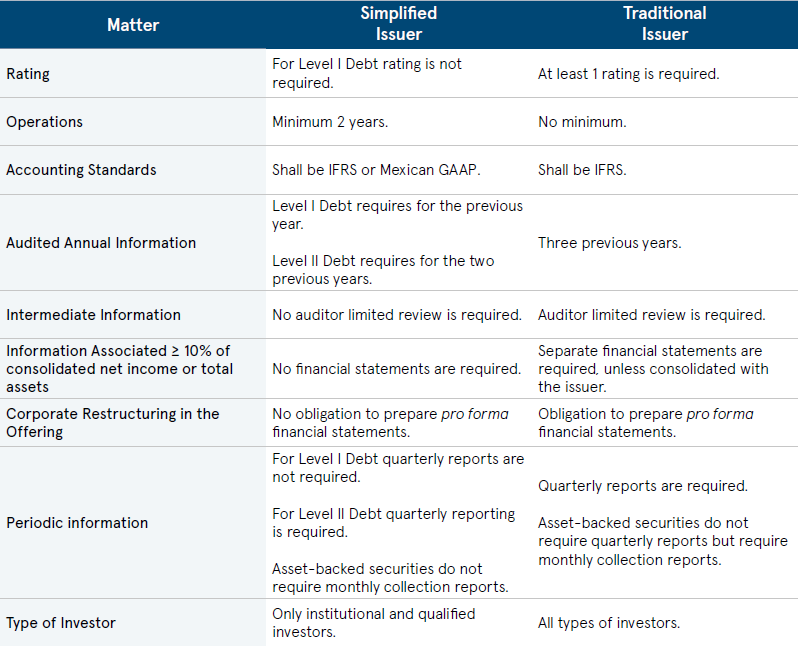
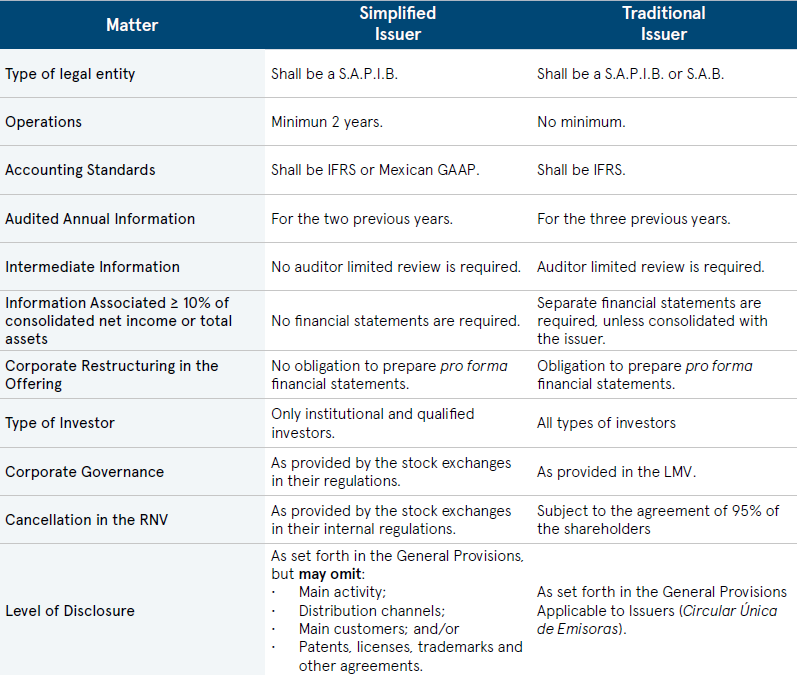
III. Differences with Traditional Issuers. Below we list some relevant differences between simplified and traditional issuers:
1. Shares:
2. Level I and Level II Debt: