
The World Cup and Ambush Marketing
A recent amendment to the Federal Law for the Protection of Industrial Property (“LFPPI”), introduced a new ground for administrative infringement aimed at sanctioning conduct related to so-called ambush marketing or parasitic marketing. This takes on special relevance in light of the 2026 FIFA World Cup, as it directly impacts the way in which companies can develop advertising campaigns and marketing strategies linked to the tournament.
What is ambush marketing and what does the LFPPI sanction?
Ambush marketing consists of attempts by non-sponsoring companies to benefit from the prestige, reputation, and commercial value of an event without having acquired official sponsorship rights1. Article 386, Section II, Subsection e) of the LFPPI sanctions acts that lead consumers to believe or assume, without basis, that an official relationship exists between a brand and a mass-gathering event. The key is to avoid generating a false association with the International Federation of Association Football (“FIFA”) or with its official sponsors. Therefore, we share below practical examples of what can and cannot be done:
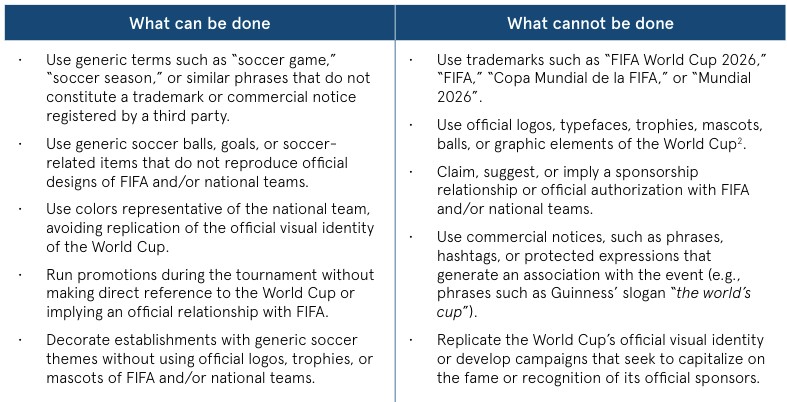
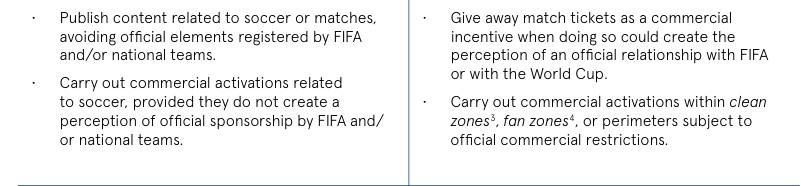
Key Considerations
FIFA has implemented commercial protection measures such as clean zones and fan zones, as well as a strengthened trademark protection strategy for the 2026 World Cup. In April 2026, the Mexican Institute of Industrial Property granted “FIFA” and the “FIFA World Cup Trophy” the status of well-known trademarks; in addition, FIFA registered more than 340 distinctive signs linked to the tournament, including: (i) the official logo of the 2026 World Cup; (ii) the names “FIFA”, “Mundial 2026”, “2026 World Cup”, “Copa Mundial de la FIFA”, and “FIFA World Cup”; and (iii) images of the mascots and designs of the official match ball.
1Pelanda, B. L. (2012). Ambush marketing: Dissecting the discourse. Hastings Communications and Entertainment Law Journal, 34(3), 341–376.
2For further reference, see the FIFA Intellectual Property Guidelines™, published by FIFA in June 2024.
3An imaginary line on a map, not a physical barrier, around FIFA World Cup stadiums and other venues where events are held, restricting commercial activities of unauthorized companies during match days and the days prior to a match within the framework of a tournament.
4Free public spaces designed to allow fans to enjoy the FIFA World Cup experience outside the stadiums.